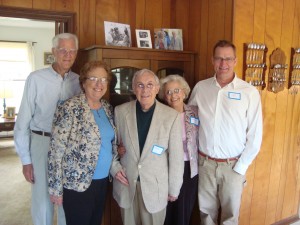
I’m back in my childhood home in Columbia, Missouri, where I’ve spent a wonderful few days with my dad and 66% of my brothers, not to mention my dad’s girlfriend, plus lots of neighbors and some dear old friends.
I love coming back to my childhood home and finding stuff in basement, closets, and drawers – familiar old favorites like the plastic characters who sat on our spoons to make cereal eating more fun, the cube-shaped cork pencil holder that is now all the retro rage on etsy, or the pink pincushion my mom and I found in an Oxfam shop in England.
This time, I also re-discovered a typewritten account called MY FATHER, written by my great-grandmother’s brother. This memoir is also the story of her father, obviously – my great-great-grandfather. Our family’s version of Little House on the Prairie, it begins with the harrowing tale of how my great-great-great grandfather Wilson Kelsey, his wife Jane, and their four boys and three girls journeyed 1200 miles from upstate New York to Wisconsin in 1855. Wilson purchased 160 acres of land in Minnesota for $1.25 per acre, and the family moved into a one room log house on the property.
Jane saved the eyes of potatoes throughout the winter. “They planted potatoes, they planted corn. The two older boys hoed the corn. The family lived in one room, slept on hard boards covered with a straw mattress, had the roughest kind of furniture, bunks and benches with a rough pine table. Jane got up at 4 AM and worked until 10 at night. She cooked over an open fire in the fireplace, her hands were busy constantly; she sewed, she knit, she busied herself with the countless household tasks from morning til night. By fall their clothes, even their shoes, were gone. Jane made pants and moccasins out of grain sacks.”
The story continues: “The family was happy. Everyone was busy. True, there was the ever-present threat of Indian raids which must have been some worry to them, but the raids did not come against them, although settlers were killed not far from Cherry Grove. But Wilson drank.
“It is entirely probably that Wilson lost one farm after another back in New York, and was reduced to becoming a day laborer, because he drank. This problem did not come up in the family in Minnesota until they began to sell their produce. They did this at Red Wing, 35 miles away. The trip took three days, was made with oxen, and required an overnight stop in Red Wing. Wilson drove there and back and did not always bring back all of the money he received for the produce. One morning when the wagon was all loaded, the oxen hitched and everything ready to go, the eldest son climbed up on the seat and announced that he was going, which he did from that time on. Wilson eventually quit drinking.”
Never do I come to my childhood home to do scholarly work, but this passage fascinated me, because I had just read a revelation in “The Botany of Desire” by Michael Pollan (which I was thrilled to find in my childhood bedroom, because I needed a Pollan book for our April book club meeting.) In this book, Pollan punctures the myth of Johnny Appleseed. Johnny wasn’t in the business of selling apples to eat. He was selling apples to drink. Pioneers, it turns out, got drunk on hard cider – applejack. “Corn liquor, or white lightening, preceded cider on the frontier by a few years, but after the apple trees began to bear fruit, cider – being safer, tastier, and much easier to make – became the alcoholic drink of choice. Just about the only reason to plant an orchard of the sort of seedling apples John Chapman had forsale would have been its intoxicating harvest of drink, available to anyone with a press and a barrel.”
Downstairs in my dad’s house, fortuitously, was another of my favorite books – Family, by Ian Frazier. Stay with me here, because Frazier sheds even more light on the story of alcohol and pioneers in this passage. “An upper-class Englishman who traveled the frontier in 1817 and 1818…said that the people he saw looked old at an earlier age than people in England. He thought this was because frontier people had few comforts and bad clothes and poor hygiene. He called the last ‘the greatest pest, the most fertile source of disorders, among them.’ Most frontier farms could be made to produce a crop of corn or wheat within the first or second year; selling the crop and shipping it were more difficult. As whiskey, it traveled better, kept longer, and could be sold or traded. Many of the Scots-Irish settlers not only knew how to distill whiskey, they were good at it. People said that some of the whiskey you got on the frontier tasted fine. For years it was much easier to find good whiskey there than good coffee. A traveler to Ohio and Indiana in 1827 reported that whiskey was drunk like water. An Indiana county history says that in those days people thought it was impossible for any man to work in the harvest field without the use of whiskey. People drank it out of bowls, teacups, gourds. Most preferred to take it straight. It was watered down and given to children. Schoolteachers were paid in it. Lake schooners were christened with jugs of it.
Before elections, candidates for public office often left barrels of it in their names for customers at groceries to help themselves. It entered even the most casual social encounters….This may all sound raffish and fun, but for many of the children who watched the effect of whiskey on ther parents, it wasn’t. The first generation to grow up on the frontier produced tens of thousands of anti-liquor reformers, members of the Women’s Christian Temperance Union and Sons of Temperance, whose cause became a nationwide movement which would eventually result in the prohibition of alcoholic beverages with the Volstead Act of 1919.”
OMG, Ian Frazier had just, in one fell swoop, explained several generations of my mom’s family. My great-grandmother indeed became a devoted member of the WCTU. So zealous was she that she even traveled to Sweden for a WCTU convention in the 1930s and brought back a pin – which I now own. As children, my grandmother and mother both signed pledges never to drink – a promise they kept all their lives. I always thought it was because they came from religious families – I never knew the backstory of their forebear, the hard-drinking frontiersman whose drunkenness nearly ruined his family and put the fear of God into several generations.
The whitewashed story of how the west was won, as taught from boring textbooks in the 1960s and 1970s, never mentioned a populace threatened by alcoholism. I’m sure I never heard a teacher or professor bring this up in a lecture. Either I was paying no attention, or this tale was simply not told. I am grateful to Michael Pollan, Ian Frazier, and old family documents for enlightening me and for explaining what is, in the end, a much richer story of American pioneering.











 Today’s post concludes with a paraphrase of someone else on the Today Show: What’s happening in the garden in your neck of the woods?

 dress shoes with white gym socks, I hesitate to make a stink and risk losing the battle and the war. However, the white sock / flood pants combo is a deal breaker. But man, it’s as if donning a colored dress sock is equivalent to walking on hot pokers.
 I honestly think they do this one just to bug me. Whenever an outfit requires a shirt tuck (i.e. with a jacket and tie, baseball pants) they insist upon leaving their shirts out, lamenting about how uncomfortable the tuck is. Yet, every now and then for no apparent reason, they embrace the tuck as if there is no tomorrow, shoving their shirts WAY down into their pants and bringing the belt up HIGH. If you thought tucking was uncomfortable, you should hear the pain they articulate to untuck.